Stop beating yourself up and do this
A guide to transmuting regret
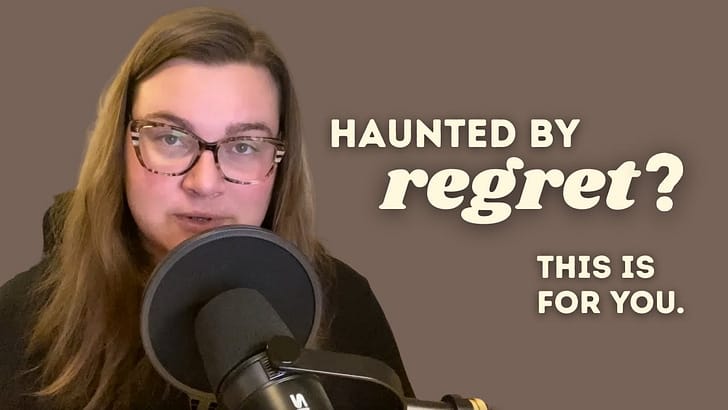
Last year, I made a post about dealing with regret. This year, I made a video!
Why? Because there are many people who get overwhelmed with a sense of regret this time of year (or anytime, actually) and I wanted to share a bit of what helps me deal with it.
Here is the video. Down below, you can find a “journaling prompts” version of it that you can use at any time.
Your guide to journaling through regret
Cultivating self-compassion
- Think about this decision, act, or situation. What did you do (or not do)?
- What led you to do (or not do) what you did (or didn’t do)?
- What was your motivation at the time?
- If you had to make a difficult decision, what were the different emotional risks and factors involved in each option? Why did the past you decide the way they did?
- Can you see how it makes perfect sense that this person did (or did not do) that? Can you see they were struggling with certain things and that actually, the way they decided makes perfect sense for them?
- What do you know or believe now that makes you regret that decision in the past?
- Can you see that you regret it today because now, you have more insight and wisdom about it? Is it possible you are being very harsh on the younger you who didn’t really know what you know now, didn’t have the experiences you have now, or didn’t trust themselves enough at the time?
- What would it look like if you were 1% more compassionate towards that younger you?
Reframing your perception
This is an approach I actually don’t talk about in the video. It is inspired by the Demartini method.1
- Describe what happened - what did you do (even if you “didn’t do” something, that means you did do something else)?
- Describe how you are currently perceiving and feeling about this. What meanings are you assigning to it? Is the way you perceive the event actually true? Even if you believe it is, what might be some other interpretations of it? How might someone else view it or feel about it or relate to it?
- What are some instances when someone else has done the same thing? If this was someone you cared about deeply, what would you say to them?
- In the moment of your decision and forwards to today, what were the benefits and services of this decision to you or others?
- What would be the drawbacks if you chose differently at the time? Is it possible that if you did something differently, things would have gone so much worse in ways you can’t even imagine right now?
- If you believed that everything that happens is always for your greatest benefit, what might be a role of this event in your life? Note: You don’t have to actually believe that, just play out this thought experiment and see what comes up.

Return to the present moment
Now that we’ve established a bit of a different relationship with that moment or event, let’s return to the present moment.
- Look around yourself. Where are you? What is in front of you, to the left, to the right, above your head, behind you?
- Take a few deep breaths.
- Feel your body. How are you feeling?
- Can you describe the current situation objectively, just citing facts? Can you drop into the current moment - no story about the past or the future?
- Now. Is there anything you can do now about the situation? It might be big, like apologising or reaching out, or it might just be allowing yourself to process how you feel about it and giving yourself time to come to terms with it.
- Is there anything you can do now that might go in the direction of what you regret not doing before? Alternatively, is there anything you can do to change what you did do before?
- Imagine yourself two years from now. What would that person advise you to do now? In other words, with the experience and insight you have now, how can you move from here so as not to have even bigger regrets later on?
Acknowledging your secret pleasure
As I mentioned in the video, this is inspired by Existential Kink by Carolyn Elliott. It’s a book I highly recommend if this kind of work is calling you and you want to get to know yourself better and alchemize all your frustrations hidden pleasures.
- Remember the moment you made the decision or did something you regret. If it’s been a recurring thing, choose one specific moment.
- Really lean into how you feel about it. Feel the regret, feel the beating yourself up.
- If you set aside the stories and meanings around it and focus solely on the sensations in your body, how would you describe them? How does it feel?
- Can you allow yourself to notice that there is a part of you that enjoys that feeling, at least a little bit?
- Allow yourself to enjoy it. The thing is, you will start to notice that a part of you actually loves feeling regret and beating yourself up. And the more you try to deny yourself that, the more it enjoys it. So allow it. And notice that once you rip away all the stories and meanings around it, all that remains is the feeling. The sensation. The energy. And you can channel that energy into anything you want.
Often, it is our desire to stop feeling this way that actually makes regret persist as long as it does.
Regret is just an emotion.
Remember that it’s perfectly normal and human and natural to feel it.
Thank you for being here 🙏
If you found this post (and video) helpful, share it with a friend.
Until next time,
Katja
I want to make it clear that I am not a Demartini practitioner nor have I ever actually attended a Demartini workshop or program. But I have read about the method and I have worked with a coach that is a really good Demartini facilitator, so I have put these questions together in a way that would help me deal with regret.
It is not *the* method, but it is inspired by my understanding of some of it, combined with some questions I find helpful in balancing out the perception. ↩